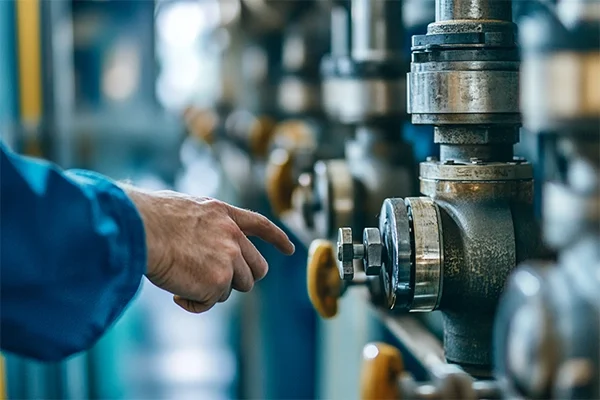
Industrial valves are essential components in naval, industrial, and port facilities. Their main function is to control fluid flow, regulate flow rates, protect equipment, and ensure that each system operates safely and efficiently.
You know that a poorly chosen valve can cause leaks, pressure losses, malfunctions, equipment breakdowns, and unexpected shutdowns. Therefore, selecting the right valve should not be based solely on size or price, but also on the type of fluid, the working pressure, the temperature, the material, the environment, and the function it must perform within the system.
Why Choosing the Right Industrial Valve Is Important
In any installation, valves perform a critical function. They can open or close the flow of a fluid, regulate its circulation, prevent backflow, relieve pressure, or isolate a part of the system for maintenance.
When working in demanding environments, such as engine rooms, ships, industrial workshops, or port facilities, you need valves capable of withstanding harsh conditions. Humidity, salinity, pressure, temperature, and continuous use can all affect a valve’s performance if it’s not properly selected.
Choosing the right valve from the start helps reduce breakdowns, improve safety, optimize maintenance, and extend the installation’s lifespan.
Ball Valves: Quick and Reliable Closure
Ball valves are one of the most widely used options in industrial and marine installations. They operate using a perforated ball that allows for quick opening or closing of fluid flow.
Their main advantage is that they offer simple, safe, and effective closure. They are especially useful when you need to completely open or close a line without requiring precise flow control.
You’ll find this type of valve frequently used in water, air, fuel, and other compatible fluid systems. Furthermore, their compact design facilitates installation and maintenance, which is crucial in confined spaces or hard-to-reach technical areas.
Gate Valves: Complete Opening or Closing
Gate valves are designed to allow or block the flow of fluid. Gate valves are not usually the best option for continuous flow regulation, but they are very useful when a complete opening or closing of the line is required.
This type of valve is used in installations where it is important for the fluid to circulate with minimal pressure drop when the valve is fully open. Therefore, they can be suitable for systems where the valve remains open or closed for extended periods.
If you need a robust solution to isolate sections of a system, a gate valve can be an interesting alternative, provided it is selected with the appropriate material and pressure rating.
Check valves: protection against backflow
Check valves perform a very important function: preventing fluid from flowing in the opposite direction. This type of valve protects pumps, pipes, equipment, and systems from unwanted backflow that can cause damage or performance loss.
In marine and industrial installations, check valves are especially useful in circuits where the flow must be maintained in only one direction. They can be used in water, fuel, air, cooling, or hydraulic systems, depending on the characteristics of each installation.
When choosing a check valve, you must consider the flow rate, pressure, fluid type, and installation location. An incorrect choice can affect proper closure and compromise system safety.
Butterfly Valves: Practical Control in Large Diameters
Butterfly valves are common in installations where fluid flow needs to be controlled in larger diameter pipes. Their design allows for quick opening and closing, taking up less space than other types of valves.
They are a practical option when you need a lightweight, functional, and easy-to-operate valve. Furthermore, they can be used for both shut-off and some flow regulation, depending on the system and operating conditions.
In industrial and marine environments, butterfly valves can be an efficient solution for water, ventilation, cooling, and other compatible applications.
Key Factors for Choosing the Right Valve
To choose the right industrial valve, you must first analyze its function within the installation. A valve designed to shut off a line is not the same as one designed to regulate flow, prevent backflow, or protect equipment.
It is also important to consider the type of fluid, the maximum pressure, the operating temperature, the material it is made of, the type of connection, and the environment where it will be installed. In the n sectorFor example, corrosion resistance is a fundamental aspect.
In addition, it’s important to consider ease of maintenance, the availability of spare parts, and compatibility with the rest of the installation. A reliable valve should perform well today but also facilitate future maintenance and replacements.
Common Mistakes When Selecting Industrial Valves
One of the most common mistakes is choosing a valve based solely on its size. While diameter is important, it doesn’t guarantee that the part is suitable for the system. Pressure, temperature, fluid type, material, and intended use must also be considered.
Another frequent error is installing a valve designed for complete shutoff in an application where regulation is needed, or using a valve without considering corrosion, vibration, or environmental conditions.
You can avoid these problems by consulting the technical specifications before purchasing and by seeking support from a specialized supplier.
The Value of Expert Technical Advice
Although many valves may appear similar, their technical characteristics can be very different. That’s why having expert advice helps you avoid purchasing mistakes and select the most suitable solution for each situation.
An experienced supplier of industrial and marine valves can guide you based on the actual use of the installation, the working conditions, and the maintenance needs. This is especially important when working with critical systems or when you need a quick response in a port, workshop, or industrial plant.
Choosing the right valve not only improves system performance but also reduces risks and costs in the long run.
Conclusion
Industrial valves are key components for ensuring the safety, control, and efficiency of any installation. Ball, gate, check, and butterfly valves perform different functions, so choosing the right one depends on the fluid, pressure, temperature, environment, and intended use.
If you opt for quality products and expert technical advice, you will reduce breakdowns, avoid unnecessary downtime, and improve the reliability of your systems. In industrial valves, choosing well from the start is always the best decision.
